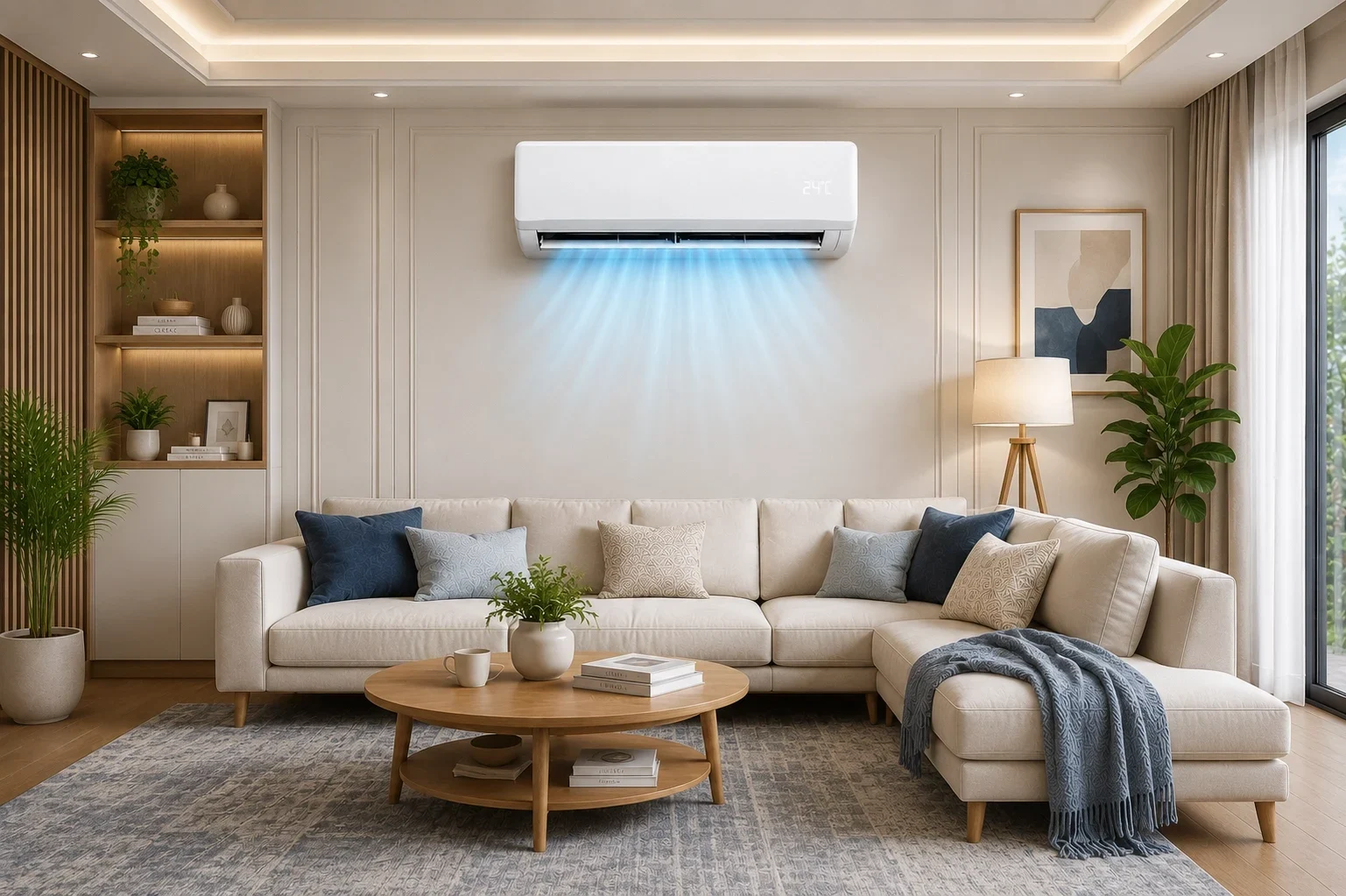
Wanting to invest in an air conditioner but failing to account for your room’s size and space requirements risks draining your finances in two ways: the purchase will cost you a lot, and you will have to incur extra energy expenses every month. An air conditioner that’s too small will work all the time yet will not cool the space effectively, while one that’s size too big will cool off the room too quickly and will cause discomfort because it will not dry the air for you.
Quick Reference: AC Tonnage by Room Size
| Room Size | Recommended AC Capacity | Typical Use |
| Up to 120 sq ft | 1 Ton | Small bedroom, study room |
| 120–180 sq ft | 1.5 Ton | Standard bedroom, most common in Indian homes |
| 180–250 sq ft | 2 Ton | Master bedroom, living room |
| 250–400 sq ft | 2.5–3 Ton | Large living room, hall |
To calculate the area of your room, you need to take the length and multiply it by the width. For instance, a bedroom that has dimensions of 12 ft x 12 ft equals 12 x 12 = 144 sq ft, which means you will need a 1.5-ton air conditioner.
Factors That Change the Calculation
The area of the room is just the beginning. There are several other factors that will change the number:
1. Roof height – The calculations above are based on the assumption that the ceiling height does not exceed 9-10 ft. If the height of your ceiling is about 12 ft, you will need to add 0.5 tons of capacity to your calculations due to the need in cooling more air.
2. Sun exposure – A west-facing room is at higher risk of heating up faster, and so is an apartment located on the top floor if it is under the roof.
3. Number of people – Different factors like the number of people living in the apartment, as well as the equipment that generates heat, need to be taken into consideration. If a room is designed for two people but has four or five most of the time, then it will need an air conditioner with a bigger cooling capacity.
4. Insulation and count of windows – The room with a large number of windows and low insulation in the walls tends to lose cool air quickly. Use of curtains, double glazing, and sealing can reduce the cooling load, thus making it feasible to follow the standard chart while choosing the AC unit in places with high temperatures.
Best AC for Bedroom in India: What Actually Matters
When considering the best AC for bedrooms in India, three key features matter more for selecting the ideal unit than its brand.
- Choosing an inverter AC rather than a fixed-speed AC – The inverter compressor works effectively by adjusting the cooling supplied by the AC, while it does not switch off; you can enjoy a constant temperature and less noise during night hours.
- The BEE star rating – The BEE rating system can save you up to 15-20% of the operating expenses during the year.
- Voltage range – When selecting an AC unit, don’t forget to verify the voltage range from 140V to 280V to use it with no stabilizer in areas where the voltage keeps fluctuating.
The reason why split air conditioners are better suited for bedrooms is due to the fact that they generate less noise compared to the window units.
Step-by-Step: Sizing Your AC Correctly
- To start, the length and width of the room should be measured in feet to calculate floor area.
- Then, see if it corresponds to the tonnage table above.
- If the room has more than a 10 ft ceiling, is sun-facing, or is on the top floor, then 0.5 tons need to be added.
- An additional 0.5 ton should be added if there are at least four people occupying the room or are heat-producing electronic items present in it.
- It is advisable to buy an inverter air conditioner with at least a 4-star rating given by the Bureau of Energy Efficiency for rooms with regular usage.
- If your final total falls between two tonnage levels, you should opt for the bigger tonnage option since having an AC running below its inverter capacity is less efficient than having a bigger AC working at its full capacity.
Common Sizing Mistakes to Avoid
- Buying the capacity according to the size of the hall for bedroom ACs, as every room has to be worked out separately.
- Not thinking about the ceiling height. If there are two rooms, i.e., having the same floor area but different ceiling heights, then they would have different tonnages.
- Buying a non-inverter ac instead of an inverter unit just to save initial cost. Within two or three summers, the difference could be eliminated with the help of power bills, and inverter units would result in better temperature control.
- Not comparing star ratings. The difference between a 3-star AC and a 5-star model could reach ₹3,000 to ₹5,000 in terms of annual running costs.
In Short
Figuring out the right AC capacity according to room size is basically about the size of the room but should also include ceiling height, sun position, number of people in the room, and insulation type. For your average Indian bedroom, a 1.5-ton, 5-star inverter split AC works as required most of the time. If your room volume turns out to be two sizes, it is better to opt for a larger inverter unit.